Produced by Department of Fisheries and Aquaculture
Government of Newfoundland and Labrador
Harp seal is a marine mammal found abundantly in the ice-cold waters of Newfoundland and Labrador. Because of their environments, harp seals have unique biological characteristics which make them interesting as a renewable resource to be harvested for human consumption.
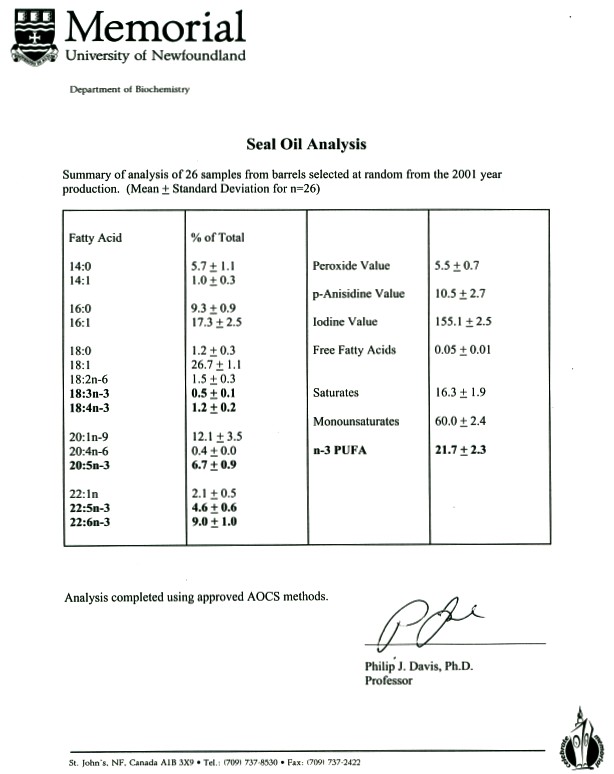
Blubber oil from harp seal is a rich source of long-chain omega-3 polyunsaturated fatty acids (PUFA) which have attracted much interest and are the focus of attention. The interest in marine oils stemmed from the observation of the diet of Greenland Eskimos in which fish as well as seal meat and blubber was important. The incidence of cardiovascular disease (CVD) in Eskimos was considerably less than that of the Danish population, despite their high fat consumption.
The beneficial health effects of omega-3 PUFA have been attributed to their ability to lower serum triglycerides and cholesterol. In addition, omega-3 fatty acids are essential for normal growth and development and may play a role in the prevention and treatment of hypertension, arthritis, inflammatory and auto immune disorders, diabetes and cancer of the breast and prostate.
Unlike saturated and monounsaturated fatty acids which can be synthesized by all mammals, including humans, the omega-3 PUFA cannot be easily synthesized in the body and must be provided through the diet. The unique feature of marine oils, such as seal oil, relates to their high content of eicosapentaenoic acid (EPA), docosahexaenoic acid (DHA), and, to a lesser extent, docosapentaenoic acid (DPA). These PUFA are formed in unicellular phytoplankton and multicellular sea algae and eventually pass through the food web and become incorporated into the body of fish and higher marine species. The high content of omega-3 fatty acids in marine lipids is suggested to be a consequence of cold temperature adaptation in which omega-3 PUFA remain liquid and oppose any tendency to crystallize.
Omega-3 PUFA not only result in a decrease in plasma lipids by reduced synthesis of fatty acids and very low density lipoproteins (VLDL), they also have a direct effect on the heart muscle itself, increase blood flow, decrease arrhythmias, improve arterial compliance, decrease the size of the infarct and reduce several cellular processes that compromise heart function. It has also been suggested that marine oils may retard atherosclerosis through their effects on platelet function, platelet-endothelial interactions and inflammatory response.
The long-chain omega-3 fatty acids have been found to have a marked effect on tissue development. Recent studies have demonstrated the DHA supplementation during pregnancy and lactation is necessary in order to prevent deficiency of the mother's DHA status during these periods in order to meet the high fetal requirement for DHA. It has also been shown that premature babies have lower levels of DHA in their tissues as compared to full-term babies. Thus, supplementation of infant formula with DHA/marine oils may be necessary in order to provide them with as much DHA as that available to their breast-fed counterparts. Feeding of infants with formula devoid of omega-3 fatty acids resulted in lack of deposition of DHA in their visual and neural tissues with its adverse effects on vision and nervous system.
In comparing seal blubber oil with fish oils, assimilation of seal oil into the body is more efficient than fish oils. EPA, DPA and DHA in seal oil are located primarily in the terminal positions of the triglyceride molecules while they are preferentially present in the middle position of triglycerides in fish oils. This difference in the location of the omega-3 PUFA is a major reason for superior effect of seal oils as compared to fish oils in disease prevention and potential health benefits. Seal oil may be used in the form of 500mg capsules or as a bottled product.
Government and Scientific Recommendation
The Government of Canada recently recommended that each Canadian between the ages of 25- 49 should take a total of 1.5 gms of Omega 3 fatty acids daily.
Nutrition Recommendations for Canadian state. "Omega 3 polyunsaturates are essential nutrients for maintaining good health, normal growth and development"
The United States Department of Health and Nutritional Services, The National Institute of Health, and The Life Sciences Research Offices of the Council for Responsible Nutrition have agreed that the daily intake of Omega 3 should increase to 1-3 grams per day. The World Health Organization (WHO) recently recommended that the daily intake of omega 3 should be increased above that consumed today by mature adults.
It is important to note that, as in the case of Vitamin C, Omega 3s do not store well in the body and therefore must be replenished on a daily basis. An Omega 3 supplement is the best method of ensuring an adequate Omega 3 daily intake.
It is highly evident that DPA is essential for inclusion in diets of infants, supporting the fact that Seal Oil is considered as a source of the essential fatty acids for pregnant women and nursing mothers. EFA supplements have been recognized as good sources of EFA's by regulatory authorities such as the National Health Service in the UK.
One of the best assessments of this problem is that of Dr. A. Simopoulos. She reports long chain polyunsaturated fatty acids 300-400 mg per day as a desirable intake. This conclusion from a NATO Advanced Workshop on Dietary n-3 and n-6 Fatty Acids appears to be the currently acceptable figures. The conclusion is that up to 2 to 4 g per day of seal oil is in fact a reasonable intake of Omega-3 long-chain fatty acids. In the seal oil the proportions of all three fatty acids are, as shown, very close to what the blood normally provides to all body organs.